

- Category: Anti-static floor mat
- Keywords: Anti-static floor mat
- Views: 28974
- Release Date:2017-07-10
Anti-static floor mat
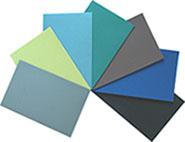
Anti-static floor mats are mainly made of static conductive materials, static dissipative materials and synthetic rubber through a variety of processes. The product is generally a two-layer structure, the surface layer is a static dissipative layer, and the bottom layer is a conductive layer. It has the characteristics of wear resistance, acid and alkali resistance, high elasticity, toughness, anti-aging, and anti-fatigue.
Product specifications: 10×0.6m, 10×0.9m, 10×1.0m, 10×1.2m
【Instructions for laying】
Lay an anti-static floor mat, then button one end of the anti-static grounding wire on the surface, and connect the other end to the conductor leading to the ground. In this way, the static electricity collected on the desktop can be discharged through the anti-static grounding wire.
Principle : 1. The green surface absorbs static electricity around the desktop.
2. The black bottom surface is a conductor, which can quickly discharge the absorbed static electricity
. 3. One end of the grounding wire is connected to the anti-static floor mat, and the other end is connected to the ground.
【Technical parameters】
1. Surface resistivity: 10 6-10 Ω
2. Bottom layer resistivity: 10 3-5 Ω
3. Abrasion rate: < 0.02g/cm 2
4. Static dissipation time: < 0.5S
5. Tensile strength: 3.6Mpa
6. Elongation at break: ***%
7. Tear strength (right angle): 20.6KN/m
8. Resilience (sample is composed of 6 layers of sheets: 14%
9. Impact brittleness temperature (no cut) -250c: no***
10. Compression*** change rate 700Cx22h, compression 25%: 17.9
[Scope of application]
Antistatic floor mats are mainly used in production workshops and professional laboratories of microelectronics industries such as electronic semiconductor devices, electronic computers, electronic communication equipment and integrated circuits. They are mainly used for paving desktops, assembly line work surfaces, shelves and making floor mats, etc., and are suitable for different conditions and different environments.
